Naked Box Man Visits the Hospital and Reveals Himself to the Nurse
The Box ManThe visit to the Hospital brings the box man and the nurse together at the threshold of a promised encounter: he arrives naked inside his box, insists that he is not the Doctor but the genuine article, and ultimately emerges from the box as she accepts his promise. The scene appears to make physical intimacy the exit from a three-year life in concealment, yet his confession that he was a fake—and the narrator’s warning about the truthfulness of the notes—turns the apparent revelation into a deliberately unstable one.
Causes and Background
The meeting follows the box man’s preparations to leave his box. At the municipal seaside bathhouse, he had cleaned his clothes, shaved, and washed himself, intending to put on his dry garments and dispose of the box. He imagined that the naked girl waiting to be seen represented the long-awaited opening out of his life in the box. The scene at the Hospital thus grows from a concrete plan to emerge, but also from his belief that a meeting with the nurse might make that emergence possible.
That plan goes awry after he falls asleep. When he wakes, the clothes he had hung out to dry are gone; he cannot leave the box without something to wear. He nevertheless hurries toward the Hospital, where he sees another box man like himself near the embankment and decides that there is no time to find trousers. His arrival naked is therefore not presented as a chosen display so much as the consequence of lost clothes, delay, and his urgency to reach the nurse.
The wider setting sharpens the scene’s concern with recognition. The account describes box men as numerous enough to be encountered but so socially ignored that people avert their eyes and public discussion keeps silent about them. The box man’s concealment is both a way of moving through the city and a barrier to being recognized as a particular person. At the Hospital, that barrier takes an intimate form: the nurse initially mistakes him for the false box man or the fake Doctor.
Arrival and Recognition
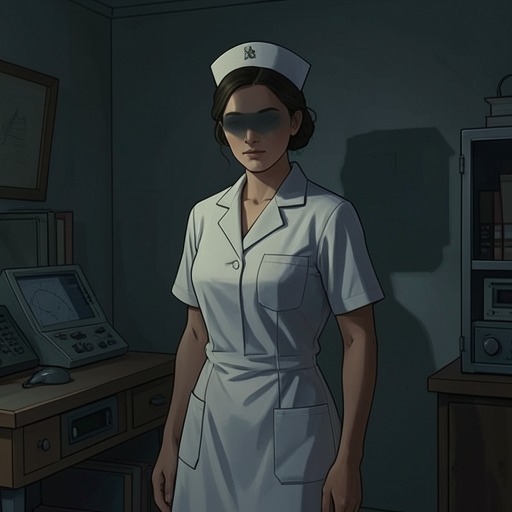
The Hospital is locked, with a notice saying that no examinations are taking place that day. The box man rings the bell impatiently, and when the door opens the nurse hastily welcomes him inside, already speaking as she turns away. She appears to believe that the expected visitor has arrived. He coughs and corrects her: he is not the Doctor but the real box man, formerly a photographer who had waited beneath the bridge the previous night.
Her response is not immediate recognition. She scrutinizes him with surprise, then reminds him that he has not kept his promise and asks him to take off the box. He says that he understands her reference to the Doctor and has seen him in the street, but cannot comply yet. He explains that he is naked because he had washed his clothes at the bathhouse, expected them to dry, and found them missing after sleeping. He had intended to come to her after getting rid of the box; instead, the lack of clothes has made the box necessary even as he rushes to fulfill the promise.
This exchange makes the box more than a disguise to be discarded at will. The nurse treats its removal as the condition for their meeting, while he describes a practical reason he cannot yet meet that demand. His claim to be the genuine man therefore has to be made while the object that obscures him remains in place. The recognition she seeks and the evidence he can offer do not coincide: he can explain his circumstances, but cannot immediately show himself outside the box.
The Promise and the Exit
The nurse first laughs in a way that seems jeering, then relaxes into amusement and a friendly manner. She accepts his nakedness as no reason to break the promise. When he asks to borrow trousers, she says she will undress too, rejecting the idea that either of them needs to be ashamed. She also makes clear that she cannot bear the box any longer. Her response changes the terms of his predicament: rather than waiting for clothing to restore the ordinary order of the encounter, she agrees to meet him as he is.
At her request, he turns away while she removes her clothes. He takes off his boots, quietly extricates himself from the box, approaches her from behind, and places a hand on her shoulder. She does not resist, and he closes the distance between them, telling himself that he must preserve this closeness. The decisive action is not simply that the nurse sees him without the box: he leaves it and approaches her, making physical departure from his shelter part of the promised meeting.
The scene seems to fulfill the transformation he had anticipated. Elsewhere he compares leaving the box to an insect emerging from a chrysalis and says that he had secretly expected the meeting to provide that opportunity. Here, the box is finally left behind, but the account does not establish a settled return to ordinary life. The moment offers an exit, not proof that the identity formed inside the box has been permanently shed.
Confession and Uncertainty
As the encounter proceeds, the man confesses that he was a fake. He then distinguishes the notes from that admission, claiming that they are genuine and were left in his keeping by the real box man. The statements complicate the scene’s central claim of recognition: the visitor first presents himself as the authentic box man, then undermines that assertion, while asking the nurse to trust a document whose provenance is itself part of the dispute.
The narrative immediately cautions against taking writing attributed to the dead as an automatic record of truth. It notes that the living may not understand the jealousy and envy of those who are dying, and that a writer who resents empty promises of truth may secure a coffin with lies. This warning does not resolve who the visitor is or which account is false. Instead, it turns the apparent revelation into a problem of evidence: the nurse’s welcome, the man’s confession, and the notes all belong to an encounter in which identity is asserted and withdrawn through narration.
The visit consequently joins bodily emergence to narrative doubt. The man leaves the box and reaches the nurse, but the account refuses to equate that action with a verified, lasting transformation. Its closing reservation keeps the promised intimacy and the claimed identity in tension, so that the scene’s outcome is both an apparent fulfillment and an unresolved question about who has been revealed.